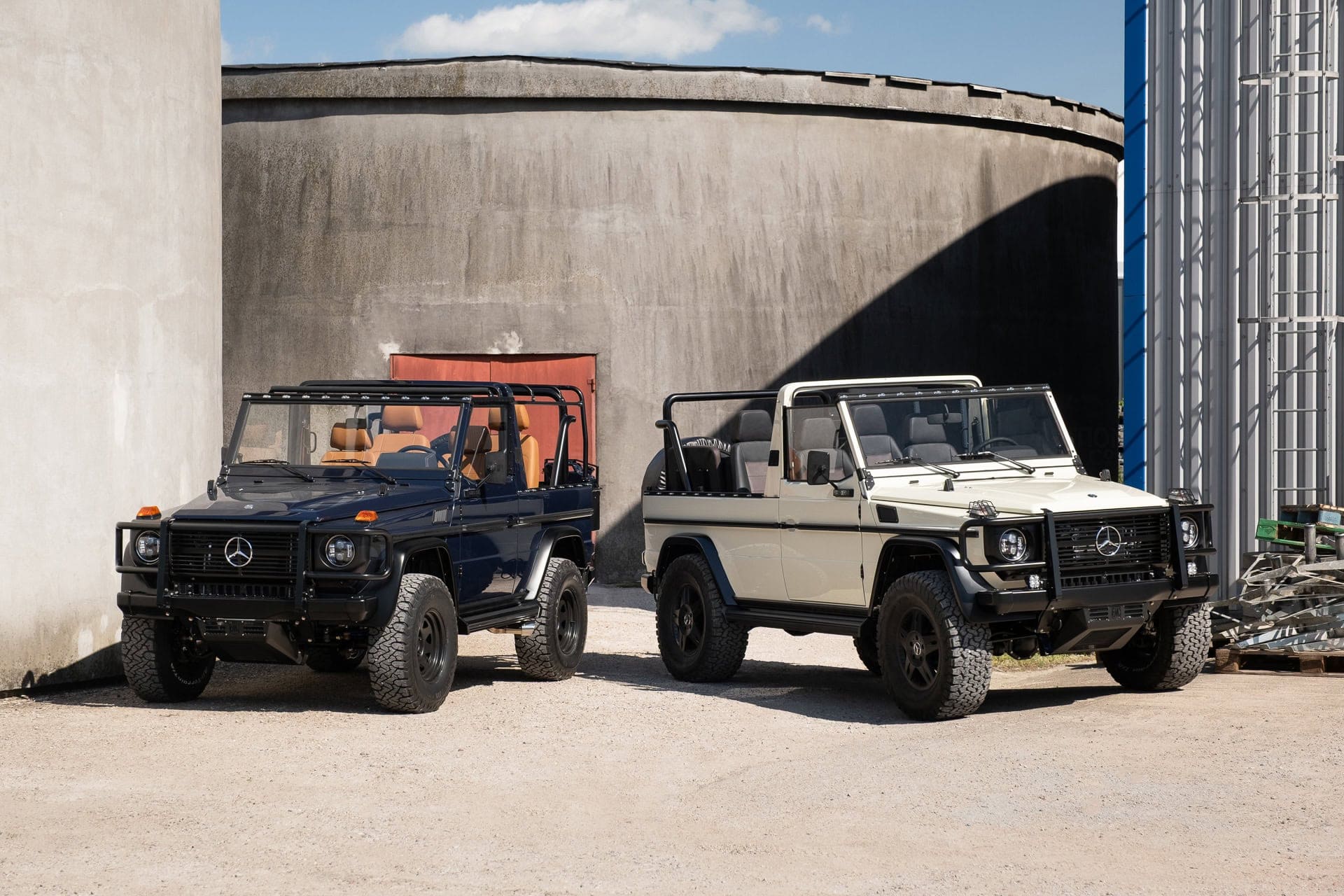

The 1990s G-Wagon: The Era That Defined the Truck
Every vintage platform has a period that collectors circle back to, and for the G-Wagon that period is the 1990s. It is the decade our entire company is built around: all 180+ trucks we have restored since 2017 were produced between 1990 and 1993. That focus was not arbitrary. The 1990s G-Wagon sits at a specific point in the model's history where the engineering had matured, the military specification reached its final form, and the luxury era had not yet changed the DNA of the truck.
What Happened to the G-Wagon in the 1990s?
The decade opened with a split. Mercedes-Benz divided the platform into two parallel lines: the W463, introduced in 1990, carried the civilian range toward the appointed, permanent-four-wheel-drive luxury vehicle the world knows today, while the W461 continued the original utility formula for military, government, and fleet customers. From that point forward, the same silhouette described two different machines.
The W461 side of the split is where the decade's most significant truck lives. In 1990 the German Bundeswehr adopted the 250GD specification and designated it the Wolf: soft-top bodies, the OM602 diesel, manual transmissions, and a build standard organized entirely around dependability, off-road performance, and field repairability. Production of these trucks ran through 1993, which is why that four-year window defines the sourcing pool for every restoration we undertake.
On the civilian side, the decade brought the naming convention still in use, as the Geländewagen formally became the G-Class in 1993, and it closed with the first full production V8 model in 1998, the step that set the truck on its path to luxury status.

Why Are 1990s G-Wagons Collectible?
Three reasons recur across the market.
The first is mechanical honesty. A 1990s W461 is one of the last expression of the original concept: solid axles, a ladder frame, manually locking differentials, and drivetrain components specified with wide margins for fleet service. The military G Wagon lineage was still the center of the program rather than its history.

The second is age. The 1990s trucks are the youngest vehicles with the original formula, which makes them the best-preserved pool of genuine examples left. They also crossed the 25-year threshold for private import into the United States only recently, with the final production years becoming eligible in 2018. A supply of sound, usable trucks reached a market that had spent decades unable to buy them, and demand has never let the moment pass.
The third is the fold-down windshield and cabriolet body style. The open-top military configuration was never sold to the public, which makes the surviving examples one of the rarest body styles in the model's history and the reason a convertible G Wagon for sale is a fundamentally different proposition from a hardtop of the same year.

Which 1990s Models Matter Most?
The 250GD Wolf of 1990 through 1993 stands first, for the reasons above. The individual model years have no specification differences between them, with the 1992 mercedes G Wagon sitting at the center of the run. Beyond the Wolf, the early W463s established the luxury pattern, and the broader family of variants across both platforms is mapped in our G Class Gelandewagen model reference for anyone tracing a specific chassis.

For buyers, the practical significance of the decade is simple: it is where originality, provenance, and usability overlap. Earlier trucks are known for driver interaction, vintage charm, and timeless styling where the newer generations provide luxury and newer tech.
What Does a 1990s G-Wagon Ask of Its Owner?
The honest answer is: it depends entirely on the truck's condition, because thirty years of European fleet service leaves every example somewhere on a spectrum from sound to a structural project. Corrosion in the frame and floors, tired drivetrain components, and improvised past repairs are the common inheritance.
That inheritance is what a proper restoration exists to resolve, and it is the reason the restored tier of the market behaves so differently from the rest.
Who Restores 1990s G-Wagons?
Expedition Motor Co. has restored the 1990s G-Wagon exclusively since 2017, with more than 180 trucks completed and delivered. Every build starts as a documented Mercedes 250GD Wolf and is taken down to bare metal in our shop, where our team of 26 craftsmen carries out the entire restoration in-house across more than 2,500 man-hours. Nothing is outsourced, and the process has been refined across six build generations, each one improving on the last.

The engineering under the restoration is our own. Clients choose from three engine options, the OM605a and OM606a turbodiesels with a Mercedes 717 five-speed manual or the 6.2L LS3 V8 with a six-speed automatic, supported by a proprietary driveline, upgraded suspension, and an AMG braking package developed for the platform. The trucks keep their analog character and gain the equipment that makes them usable every day: air conditioning, heated seats, wireless Apple CarPlay, and a weatherproof interior offered in more than 35 colors.

Each completed Wolf is delivered with a one-year bumper-to-bumper and 2-year powertrain warranty, so each truck that leaves Frenchtown carries the decade's character without the decade's wear. The 1990s made the G-Wagon what it is. Our work is making one live up to that.
Buyers can begin that process in the Wolf Builder custom G Wagon configurator.
